the epic advantage
with vic keller
You're winning the wrong game
3 min read
Hey Reader,
If you dream of building a business you can exit big someday…
Then your goal today should not be more revenue. It should not be more profit, either.
Your #1 goal as a founder should be this:
Make yourself unnecessary.
Let’s talk about the exit secret hiding in plain sight…
Worth Saving
Quote of the Week
Most founders spend a decade building a profitable business. Then, they discover they never built a transferable one.
Audio Advantage
This Week's Insight





The Business Nobody Wants to Buy
Most profitable businesses are bad assets.
Not because they’re not making money.
Because the money is attached to a person.
I’ve watched founders build genuinely impressive businesses – real revenue, real margins, real growth – and still get ghosted by buyers. A business that looks great on a P&L can look like a liability in due diligence.
Here’s what most founders never get told until it’s too late:
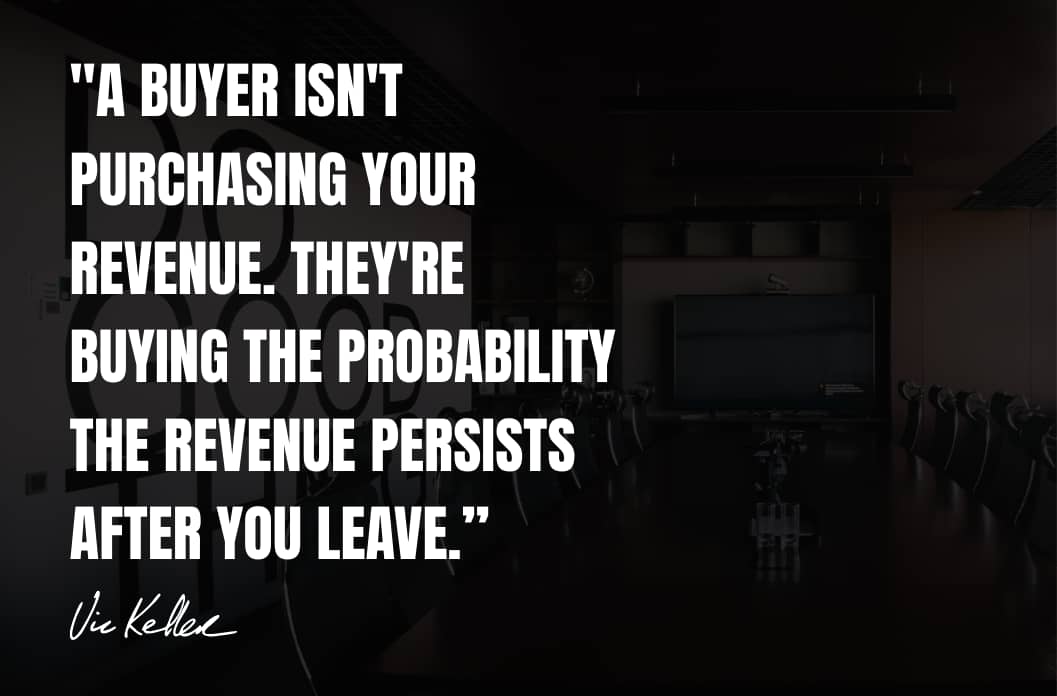
A buyer isn’t purchasing your revenue.
They’re buying the probability the revenue persists after you leave the building.
That’s it. That’s the whole game.
The Math Nobody Wants to Face
Valuation is simple on paper:
Enterprise Value = EBITDA x Multiple
Say your business does $500K in EBITDA. At a 5x multiple, you’re looking at a $2.5M exit. At 3x, that’s $1.5M. Same business. Same profit. One million dollar difference – solely based on how risky a buyer thinks you are.
Most founders obsess over EBITDA. Which makes sense. It’s a visible, trackable scoreboard you feel you have some control over.
But buyers obsess over multiple. Because the multiple is a risk price.
Buyers don’t get paid for being optimistic. They get paid for being right.
So they don’t ask, “how much money does this business make?”
They ask, “how much of this money stays after the founder walks out the door?”
If a buyer can explain your risk in one sentence, your multiple drops. If they can quantify it, it drops faster.
Want to know the exact risks they’re looking for?
The 4 Places Buyers Find Their Discount
There are 4 places that uncertainty (aka, risk!) reliably shows up. Most founders don’t see them until they’re sitting across from a buyer who does.
Find them first:
1. Revenue concentration
What the buyer is asking: “If I lose one customer, how bad does this get?”
Pull your revenue by customer. Then calculate your top customer as a percentage of total revenue.
When that top customer is too big, they become a risk.
How big is “too big”?
This is the rough rule buyers use (varies by industry, but the logic holds):

2. Relationship concentration
What the buyer is asking: “Will customers and vendors transfer, or will they leave with the founder?”
If the relationship lives in your phone, the revenue is not transferable.
Buyer translations:
- “We love the founder” = “this deal is fragile”
- “Customers request him” = “we are underwriting key person risk”
3. Undocumented everything
What the buyer is asking: “How much of this is written down vs. living in someone’s head?”
If pricing is “how we feel that day” → buyers assume margin leakage.
If delivery depends on tribal knowledge that lives in three people’s heads → they assume execution risk.
Both assumptions mean a lower multiple.
4. Leadership depth
What the buyer is asking: “Who runs this place when the founder isn’t here?”
One exceptional leader is fragile.
Three capable ones is durable.
If the org chart has empty boxes under the founder, the buyer assumes they’ll have to build what you didn’t. That cost comes directly out of your price.
The Tuesday Test
There’s a simple diagnostic I use that’s more honest than any due diligence checklist:
Pick a random Tuesday. Go completely dark for 30 days.
What breaks first?
Not what slows down. Not what gets a little messy. What breaks.
An area of your business is “broken” if, in your absence, it:
- Halts entirely. Nothing moves, because no one but you knows about the task.
- Freezes in a decision vacuum. Nothing moves, because no one knows what the right next step is, and you aren’t there to tell them.
- Fails visibly. Things move, but delivery is slow, quality is poor, and errors slip through.
If any of these areas break, you have a value problem:

What’s your score?
- 0 breaks: Your business is an asset. Protect it like one.
- 1-2 breaks: You have addressable gaps. These are fixable in 90 days with the right focus.
- 3-4 breaks: You have a transferability problem. Buyers will find it. Better you find it first.
- 5+ breaks: You’re not running a business. You’re running a job with employees.
Two or more breaks? Your business is founder-powered.
Founder-powered businesses trade at a discount – if they trade at all.
The Thing Worth Sitting With
Profit answers one question:
Does this business work today?
Enterprise value answers a different one:
Will it work without you?
Most founders spend a decade building the answer to the first question. Then they discover – often at the exact moment they want to exit, step back, or breathe – they never built the answer to the second.
Run the Tuesday Test this week. Be honest about what breaks. Write it down in a list.
That list isn’t a report card – it’s a roadmap.
Next week, we build the fix.
PS: Tonight I go live for 90 minutes in a completely FREE training.
You don't want to miss this.
Next steps
Action is the Advantage
I do not write this newsletter to motivate you. I write it to move you.
So here is what I want you to do this week:
✓ Run the Tuesday Test.
✓ Pull your revenue by customer.
✓ Pick 1 process that lives entirely in your head and spend 30 minutes writing down exactly how you do it.
✓ Reply with your answer. I’ll hold you accountable to fixing it.

Vic Keller
17x founder. 9 exits. 3 to Berkshire. Subscribe to get the advantage I wish I had when I started.