the epic advantage
with vic keller
You’re chasing market share the wrong way
3 min read
Hey Reader,
If you think share is won by pushing harder into the market, you’re not alone.
But in competitive markets, that tactic quietly breaks.
Today I want to show you where market share actually moves.
But a quick update first...
This is the last call for EPIC Success 2026 in Montana. This live, in-person gathering will be March 23-24. We can fit up to 3 more founders.
Apply today. We’re locking this in shortly.
Worth Saving
Quote of the Week

If customers have to think before picking you, you’re already losing share.
Audio Advantage
This Week's Insight





You’re Chasing Market Share the Wrong Way
One of the most aggressive market share gains I have ever been part of happened during a year when we froze spending.
No growth budget.
No brand relaunch.
No ad blitz.
What changed was not adding. It was removing.
How do you gain share by doing less?
That question is the point.
Why Market Share Thinking Is Broken
Most operators are trained to think in noise economics, where:
- Market share = expansion
- You try to pull value from the outside in.
- More reach, more spend, more motion, more presence.
The instinct is right. If you want more market share? Go out and get it.
And that works in rising markets.
But it fails quietly in competitive ones.
In mature or tightening markets, share does not move because you are louder. It moves because you’re easier to choose.
This is being an operator who thinks in durability economics, where:
- Market share = depth
- You strengthen the business from the inside out.
- The two levers of market share: make it easy to join, painful to leave.
The reason durability economics works is the same reason it’s so dangerous:
The answer to more market share doesn’t live with your competitor. It lives inside your own operations.
The Two (Overlooked) Levers of Market Share
Market share doesn’t move at the top of the funnel.
It moves at points of hesitation.
If a customer hesitates before buying from you, where exactly does that hesitation come from?
Some common answers I see over and over again:
- Price
- Complexity
- Trust
- Time
- Uncertainty
Whatever it is, if you cannot name it clearly, you cannot remove it.
And chances are, your problems are causing one of two leaks in your operational pipeline:
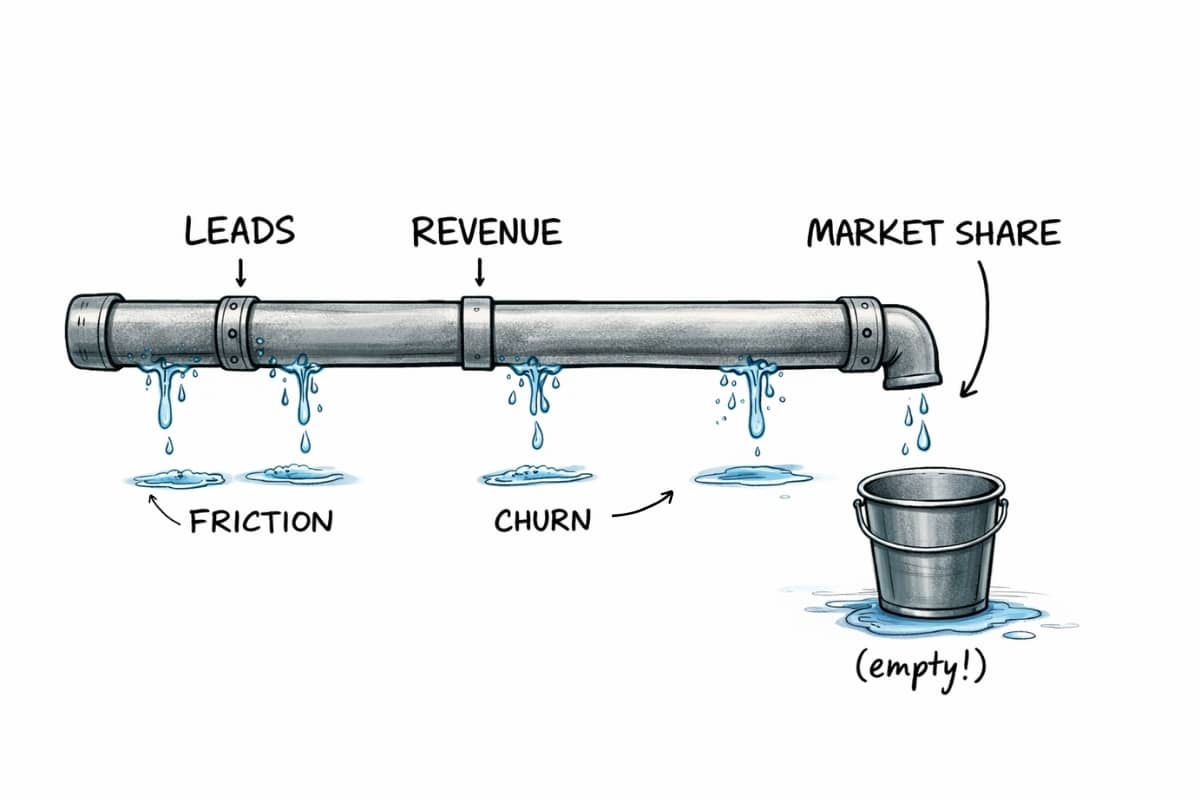
These leaks are also the levers of market share:
- Friction: Make it easy to start with you.
- Churn: Make it hard to leave.
Lever #1: Make it easy to start (Friction Removal)
Friction is anything that slows a customer decision or creates doubt.
Operators often tolerate friction because it feels normal internally. Meanwhile:
- Every extra step in your buying process lowers sales.
- Every confusing offer makes a customer hesitate.
- Every “we’ll get back to you” gives buyers time to reconsider.
That’s friction tax.
Where are you paying it?
Run this quick diagnostic:
Buying friction
- Can a customer understand your value in one sentence?
- Does pricing require explanation or justification?
- Is starting with us easier than doing nothing?
Delivery friction
- Are handoffs clean or personality-dependent?
- Is onboarding documented or tribal?
- Does execution vary by person or by system?
Support friction
- Is help proactive or reactive?
- Do customers know where to go without asking?
- Are issues solved once or repeatedly?
Do not attempt to fix everything at once.
Pick one friction point that customers complain about quietly. Fix that first.
Lever #2: Make it hard to leave (Replacement Difficulty)
The data says: in mature markets, just a 5% increase in customer retention can lift profits by 25-95%.
Common sense says: the longer you keep your customers, the less your competitors have them, the more market share you have.
So the fastest way to lose market share is to be easy to replace.
Many companies confuse good relationships with defensibility.
But relationships travel. Systems stay.
Ask these questions honestly:
- If your top salesperson left, would customers follow?
- If pricing changed slightly, would customers leave?
- If a competitor copied your offer, what would remain unique?
Replacement difficulty comes from embedded behavior.
Things customers rely on without thinking:
- Data
- Process
- Habit
- Rhythm
If customers log in weekly, follow your rhythm, or depend on your reporting cadence, replacement becomes painful.
Daily or weekly usage is defensibility. Quarterly interaction is fragility.
As long as customers rely on you in ways they cannot easily replicate elsewhere, you gain share without asking.
The Enterprise View
Now step out of the operator seat.
Imagine selling the business:
- Would a buyer say revenue is strong but customers are portable?
- Would they worry the founder is the glue?
- Would they discount value because systems are informal?
Market share that compounds lives inside structure, not effort. If growth disappears when you step back, you are not gaining share. You are personally carrying it.
No buyer pays a premium for revenue they have to personally defend.
The Uncomfortable Truth
Here is the part people don’t like to say:
You can grow revenue while losing strategic position.
You can be busy while becoming easier to replace. You can feel momentum while the asset weakens.
That is why market share gained without durability disappears first.
The companies that win share in today’s market do not try to be louder.
- They become easier to choose.
- They reduce the friction competitors tolerate.
- They embed themselves into customer behavior.
Market share is not taken by doing more.
It is taken by being easier to choose, harder to replace, and operationally impossible to ignore.
That is the work.

P.S. Want clarity on the 3-5 moves that'll drive 80% of your results in 2026? Grab one of the remaining spots for EPIC Success 2026 in Montana before they're gone.
Next steps
Action is the Advantage
If you’re like me, your to-do list is long. So I pulled out the highest-leverage actions from this week’s newsletter.
✓ Rewrite your value into a 1-sentence, 10-second yes for a new buyer.
✓ Fix the top complaint customers mention quietly.
✓ Reply with your business's leaks, and I’ll give you my two cents.

Vic Keller
17x founder. 9 exits. 3 to Berkshire. Subscribe to get the advantage I wish I had when I started.