the epic advantage
with vic keller
Your revenue has a blind spot
3 min read
Hey Reader,
Based on effort alone, your business would be worth a 15x+ multiple when you sell.
The problem is, buyers don’t care about how hard you work. They care about predictability.
So here’s how you can reduce your personal effort and increase your business’s predictability at the same time…
Worth Saving

Quote of the Week
Most founders are building income. Very few are building a business. A great month doesn't make a great business… Great Revenue Design does.
Audio Advantage
This Week's Insight





The Word That Makes Buyers Lean Forward
Years ago, I sold one of my first companies.
We were a machine. Growing fast, adding customers weekly, and expanding into new markets. When we started fielding acquisition offers, I assumed we’d be valued at 8-10x EBITDA.
The buyer’s CFO looked at our books, looked up at me, and said six words I’ll never forget:
“Great business. You’re worth 4x – maybe.”
I didn’t get mad. I got curious.
To me, we were printing money and growing fast.
But to him? We were a risk.
For one simple reason: 90% of our revenue reset every month. Which meant 90% of our cash flow depended on customers choosing us again, every single month. No contracts, no guarantees. Just hope that happened to feel like momentum.
We weren’t predictable.
That conversation could have cost me millions. Instead, it helped me turn things around before it was too late…
Why revenue fools you
Most founders believe valuation is a size game.
Hit the revenue number, buyers line up. Grow fast enough, the multiple takes care of itself.
Here’s what’s actually true:
Buyers don’t pay for what you sell. They pay for certainty about what comes next.
Before any serious buyer writes a check, they’re silently asking 3 questions:
- How much of this revenue is contracted or guaranteed?
- How much of it depends on the founder’s personal hustle to exist?
- How many customers have to say yes again next month for this business to survive?
Every “no” to those questions cuts your multiple in half.
Every “yes” doubles it.
That’s why businesses with predictable revenue streams – subscriptions, memberships, service contracts, repeat purchase programs – get triple the valuation of an identical businesses with one-time transactions.
Predictability is the multiplier.

Revenue Design: Same company, 3x the value
After that CFO conversation, I didn’t rebuild the product. Or replace the team. Or change what we sold or who we sold it to.
I just changed how customers paid for it.
Same service. But instead of one-off transactions, we:
- Offered annual maintenance programs
- Bundled packages instead of à la carte
- Created subscription-style agreements
Nothing about what we did changed. Just how customers paid for it.
18 months later, we sold for nearly 3x what that same buyer had offered before.
To be clear: this is not a growth story.
We didn’t 3x our revenue. We just restructured how that revenue was built, and the multiple reflected it.
Revenue Design is the structural decision about how customers pay for what you sell. Completely separate from your product, your pricing, and your sales strategy. Most founders never think about it deliberately. They just end up with whatever model felt easiest to close deals with early on.
That default choice is either building optionality into your business or quietly destroying it.
How to engineer predictability
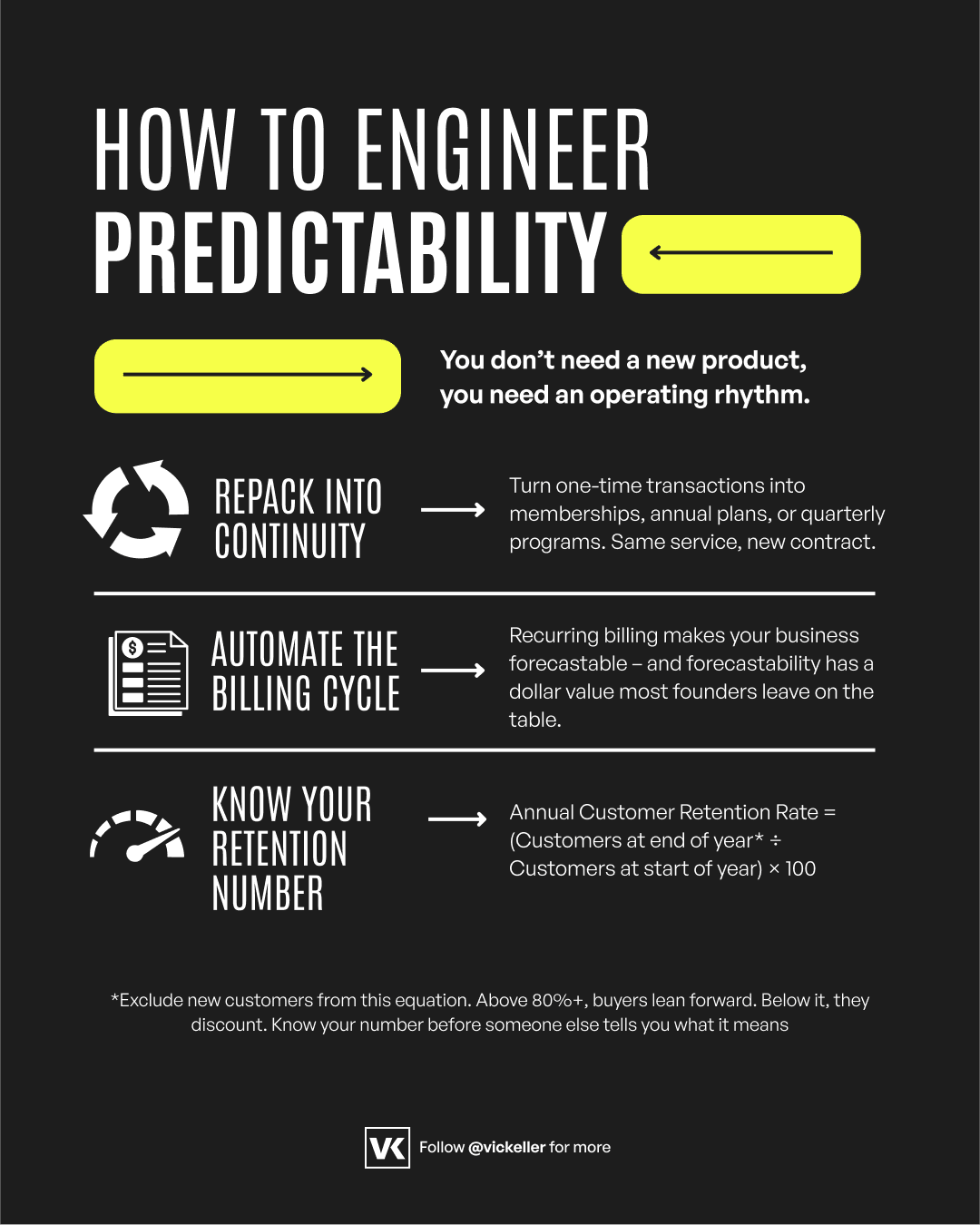
You don’t need a new product. You need a new operating rhythm.
1. Repack into continuity.
Ask yourself one question: how do I make this ongoing instead of one-time?
Could it be a tiered membership? Annual service plan? Quarterly reorders? An “upgrade protection” program.
These aren’t new products – they’re new contracts. The customer gets the same thing. You get predictable cash flow.
2. Automate the billing cycle.
The moment a business moves from chasing invoices to automated recurring billing, the business becomes modelable — meaning anyone who needs to bet on its future can actually forecast it.
That forecastability has a dollar value. Most founders leave it on the table.
3. Know your retention number.
80%+ annual renewal rate is the threshold where a buyer’s model changes. Below it, they discount. Above it, they lean forward.
Know your number before someone else tells you what it means about your business.
This isn’t about exits
If you’re reading this with no plans to exit, good. This still matters.
The same things that make buyers pay premium multiples are the exact same things that make your business less stressful to run today.
Predictable cash flow. Revenue that doesn’t need you in the room. Customers who stay.
You’ll find out what your Revenue Design looks like one of two ways. From a CFO across a negotiating table. Or right now, before the stakes are that high.
One of those conversations is a lot more expensive than the other.

Next steps
Action is the Advantage
I do not write this newsletter to motivate you. I write it to move you.
So here is what I want you to do this week:
✓ Calculate your annual renewal rate. Is it over or under 80%?
✓ Identify one service you could repackage into an annual or recurring contract, without changing what you deliver.
✓ Reply with your answers & I’ll hold you accountable.
Vic Keller
17x founder. 9 exits. 3 to Berkshire. Subscribe to get the advantage I wish I had when I started.