the epic advantage
with vic keller
Your business has one point of failure. You.
3 min read
Hey Reader,
Founder dependency.
It’s the reason you can’t take a day off, the reason your growth feels stuck, and the reason your business will sell for way less than you want someday.
Here are your first 4 steps to fix it.
Worth Saving

Quote of the Week
Most founders spend a decade building a profitable business. Then, they discover they never built a transferable one.
Audio Advantage
This Week's Insight





The Business That Doesn’t Need You
Most founders know their business is too dependent on them.
Your team relies on you to lead every project, handle every escalation, close every deal…
But you don’t know how to change it without everything falling apart in the process.
So you keep going. Keep being the one person who has to be directly involved in everything. You tell yourself you’ll fix it “when things slow down.”
But things don’t slow down. And the founder dependency compounds.
The reason why you feel so stuck? You’re trying to climb out of a hole with no ladder.
I’ve watched this pattern play out more times than I can count.
Here’s the 4-stage “STEP Ladder” so you can start climbing your way out of founder dependency:

S - Spread revenue concentration
If one customer represents more than 15% of your revenue, you don’t have a customer. You have a boss. And when a buyer sees it, they see a single point of failure with an invoice attached.
Your target should be to have no single customer over 10-15% long-term.
What this doesn’t mean: Accept less revenue or work from that primary customer.
What it DOES mean: Increase your other revenue sources ASAP.
- Build a named list of 30 to 100 accounts you can win in 12 months
- Create a sales motion that does not require founder involvement
- Restructure pricing so you can profitably pursue smaller accounts
- Get at least one customer under contract with clear renewal terms
T - Transfer relationships from you to the company
I’ve seen this one be the toughest for some founders. Because it can feel like betrayal. Like you’re pushing away the people who chose to work with you personally.
But it’s not a thoughtless handoff. It’s a system.
The playbook:
- The “two in the box” rule: every account has at least two company relationships, not one.
- Build a meeting cadence that treats your team as owners, not attendees.
- Create escalation paths that don’t route through your cell phone.
- Have customers sign off on success metrics that your team can deliver.
If a customer says “I only work with you,” that is not a compliment. That’s a leadership problem disguised as loyalty.
E - Encode tribal knowledge into SOPs
Right now, you’re being the primary brain of the operation.
The most valuable operational knowledge in your business is probably spread across you and three other people’s heads.
That knowledge isn’t an asset until it’s documented. Until then, it’s a liability. It leaves when people leave, and buyers price that risk aggressively.
You don’t need bureaucracy, but you do need transferability.
Start by getting these down on paper:
- Pricing logic: how you decide price, discount, terms
- Onboarding: how customers get set up
- Delivery: how work actually gets produced
- Escalation: what triggers leadership involvement
- Quality: what “done right” looks like
Aim for one standard: a competent CEO could operate in full swing without you within 90 days based on your documentation.
P - People layer is added & empowered

You need a second layer.
One exceptional leader is fragile. Three capable ones is durable.
If every function in your business requires your daily input to run, you haven’t built a leadership team – you’ve built a dependency structure with titles attached.
You might think, “I just need better people.” Allow me to push back on that.
Most founders already have good people. The real fix is transferring actual decision rights to them:
- Define decision rights by function
- Define outcomes by function
- Weekly meetings are reviewing metrics, not decisions
- Tolerate different paths to the same outcome
Most founders don’t lack capable talent around them. They just can’t break the habit of pulling authority back to the center.
10-point readiness test
Before you call a banker or start thinking about exit, run this check. Answer yes or no.
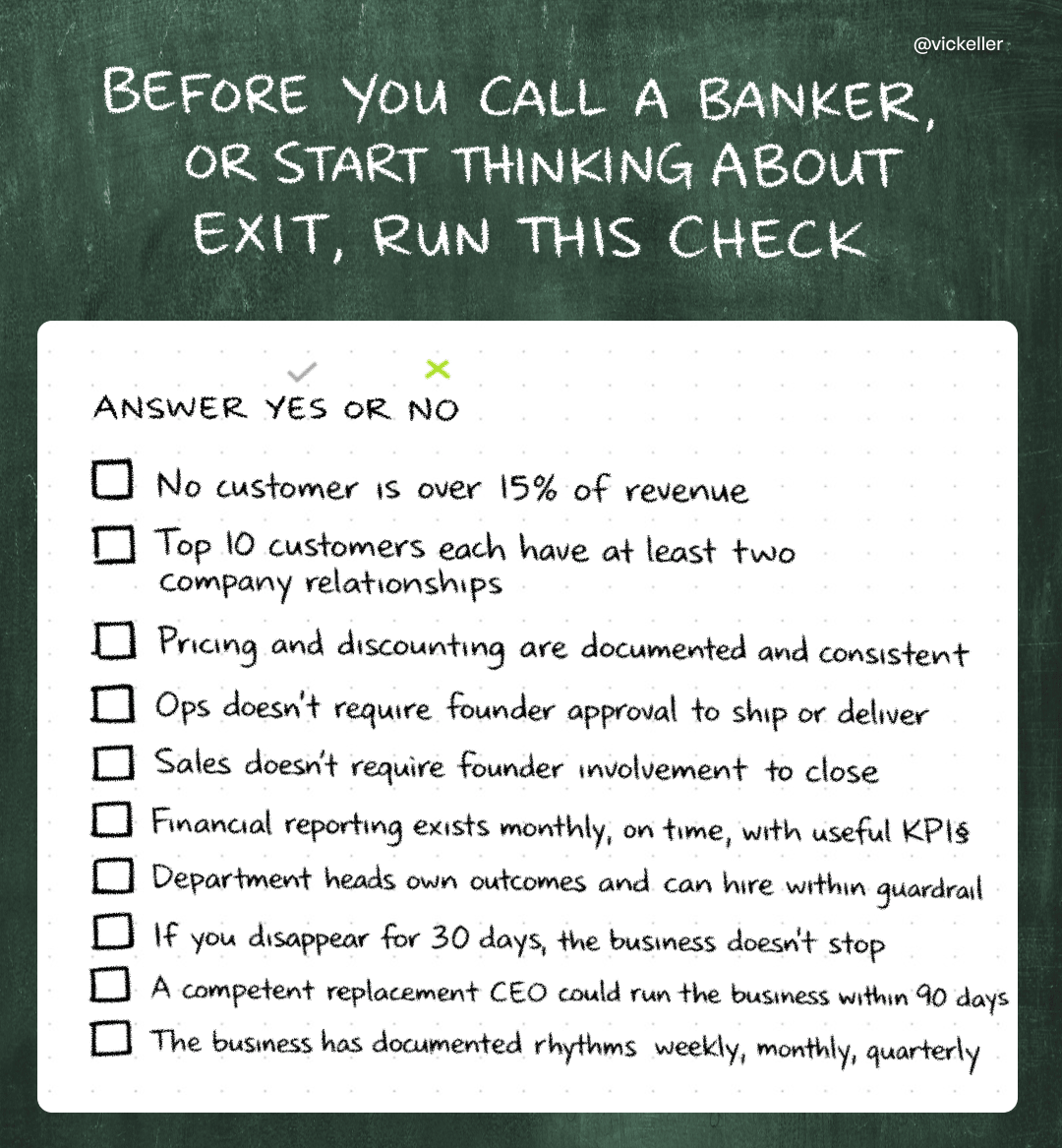
If you can’t score 7 yeses out of 10, you’re not building an asset yet. You’re still building dependence.
That’s fixable. But it’s not easy. And it’ll never improve as long as you’re being the bottleneck.
Stop asking, “how do we grow?”
Start asking, “how do I remove myself from the machine?”
That’s enterprise value. That’s durability. That’s what serious buyers pay for.

PS: If you are serious about building a durable business that can scale beyond you, I’m opening something new for operators who want to do exactly that. Click below to join the waitlist and get early access to founding member details.
Next steps
Action is the Advantage
I do not write this newsletter to motivate you. I write it to move you.
So here is what I want you to do this week:
✓ Assign 2 people who aren’t you to every single account.
✓ Schedule them into every interaction with that account for the next 30 days.
✓ Run the 10-point readiness test.
✓ Reply with your readiness test results & I’ll keep you accountable.
Was this email forwarded to you?

Vic Keller
17x founder. 9 exits. 3 to Berkshire. Subscribe to get the advantage I wish I had when I started.