the epic advantage
with vic keller
Capital is ghosting you for a reason
3 min read
Hey Reader, Do you need capital? Let’s talk about why you’re not getting it (from my view on the other side of the table…)
Worth Saving
Quote of the Week
You should never take failure as a sign to give up. Just a sign to pivot and try again.
Audio Advantage
This Week's Insight





How to Get REAL Capital to Want to Work With You
In the last 25 years, I’ve founded 17 companies from the ground up and invested in over 200 businesses.
I get a lot of questions from entrepreneurs about growth capital and equity.
Let me give you the real answers today:
You don’t ask for equity because you’re stuck.
You ask because you’ve graduated out of the amateur capital pool, and you can feel the next room... But you don’t have the door code yet.
That’s the point where the question changes.
It’s not: “Where do I find money?”
But: “How do I become the kind of operator capital already trusts?”
The Uncomfortable Truth About Capital
Capital does not back deals.
Capital backs people who remove uncertainty.
If you take one thing from this email, it’s that.
Early on, almost everyone starts looking in the same place for capital:
- Friends.
- Family.
- Small checks.
Good intentions. That works for a while.
Then quietly, without warning, it becomes the ceiling.
And most people never understand why.
Why Friends and Family Capital Eventually Fails You
I often encourage people to move away from friends and family capital sooner than they expect.
Not because it’s wrong, but because it trains the wrong muscle.
- Friends invest because they trust you.
- Institutions invest because they trust systems.
Those are fundamentally different things.
One rewards optimism.
The other demands evidence.
Friends and family forgive mistakes.
Institutions document them.
Friends invest emotionally.
Institutions invest structurally.
That difference is why so many founders feel “stuck” when they try to raise real capital for the first time.
They’re still communicating like someone asking for trust.
Serious capital isn’t looking for trust. It’s underwriting risk.
What Serious Capital Is Actually Listening For
Family offices, private equity groups, and disciplined allocators are not looking for excitement.
They are looking for confidence without theatrics.
Every conversation, whether spoken or not, is filtered through three questions:
- Can this person see risk clearly?
- Can they communicate without selling?
- Can they run this without me worrying?
If the answer to any one of those is unclear, the conversation doesn’t blow up. It simply ends. Politely. Quietly. Without feedback.
This is where most founders misread the situation.
Where You Misdiagnose the Problem
Most founders assume their capital problem is a network problem.
“I’m not getting positive reactions because I don’t have enough (or the right) intros.”
This is rarely the case.
You do not expand your capital base by asking for introductions. That almost never works at scale.
Introductions amplify signal, but they do not create it. If the signal is weak, intros just accelerate rejection.
Capital networks expand when the underlying quality improves.
That quality is not volume. Or activity. Or confidence.
It is disciplined thinking.
Capital moves toward people who think cleanly under pressure.
The Operator Shift That Actually Changes the Game
Take it from someone with experience on the other side of the deal table…
Here’s what actually moves the needle on capital sourcing:
1. Your Deal Narrative Must Be (The Right Kind Of) Boring
Rule of thumb: If your pitch feels exciting, you’re in trouble.
Serious capital prefers inevitability over upside stories.
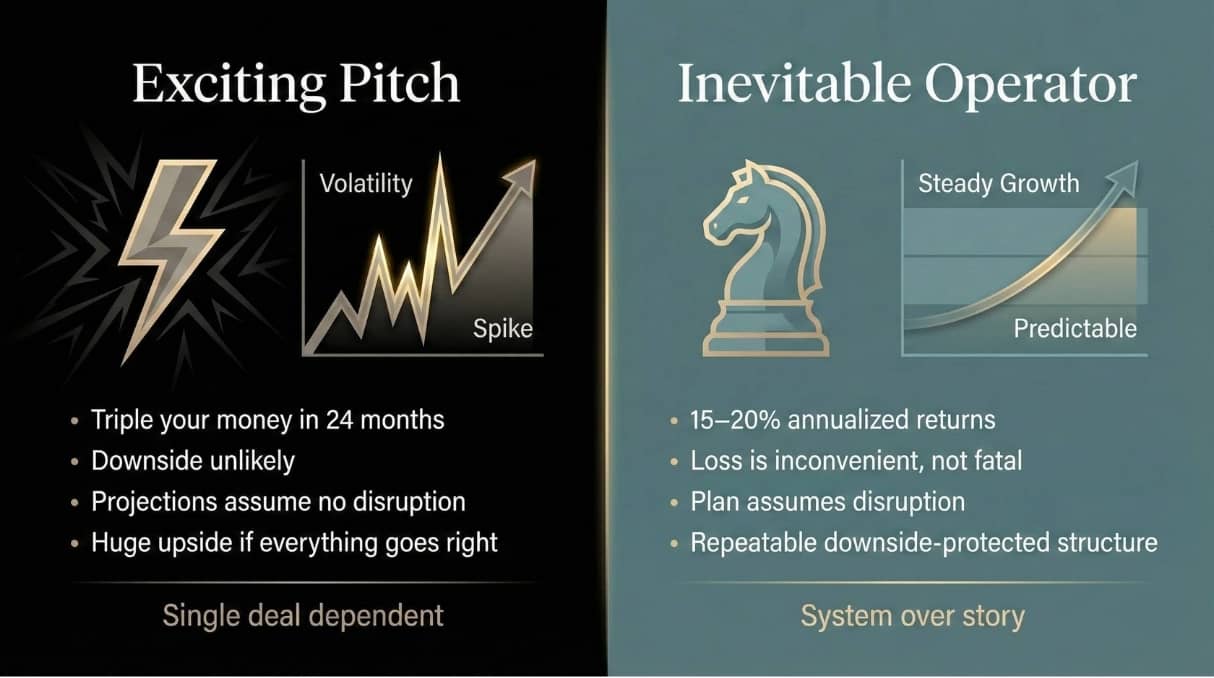
Promoters talk about what could happen.
Operators talk about what still works when things go wrong.
See if you can tell the difference…
Exciting Pitch Language:
- “This is a huge opportunity”
- “The upside is massive”
- “Worst case is still pretty good”
- “This market is exploding”
- “We are uniquely positioned”
Inevitable Operator Language:
- “Here is what would break first”
- “Here is how often that happens”
- “Here is what we do when it does”
- “Here is what does not change”
- “Here is why this still works at lower volume”
Changing your pitch posture doesn’t lessen your ambition. It increases your credibility.
2. Repeatability Beats Brilliance Every Time
One good deal is luck. Two is coincidence. Three with the same structure is a system.
Brilliance tells a good story, but it’s not the thing that attracts capital.
Systems attract capital, and repeatability creates confidence.
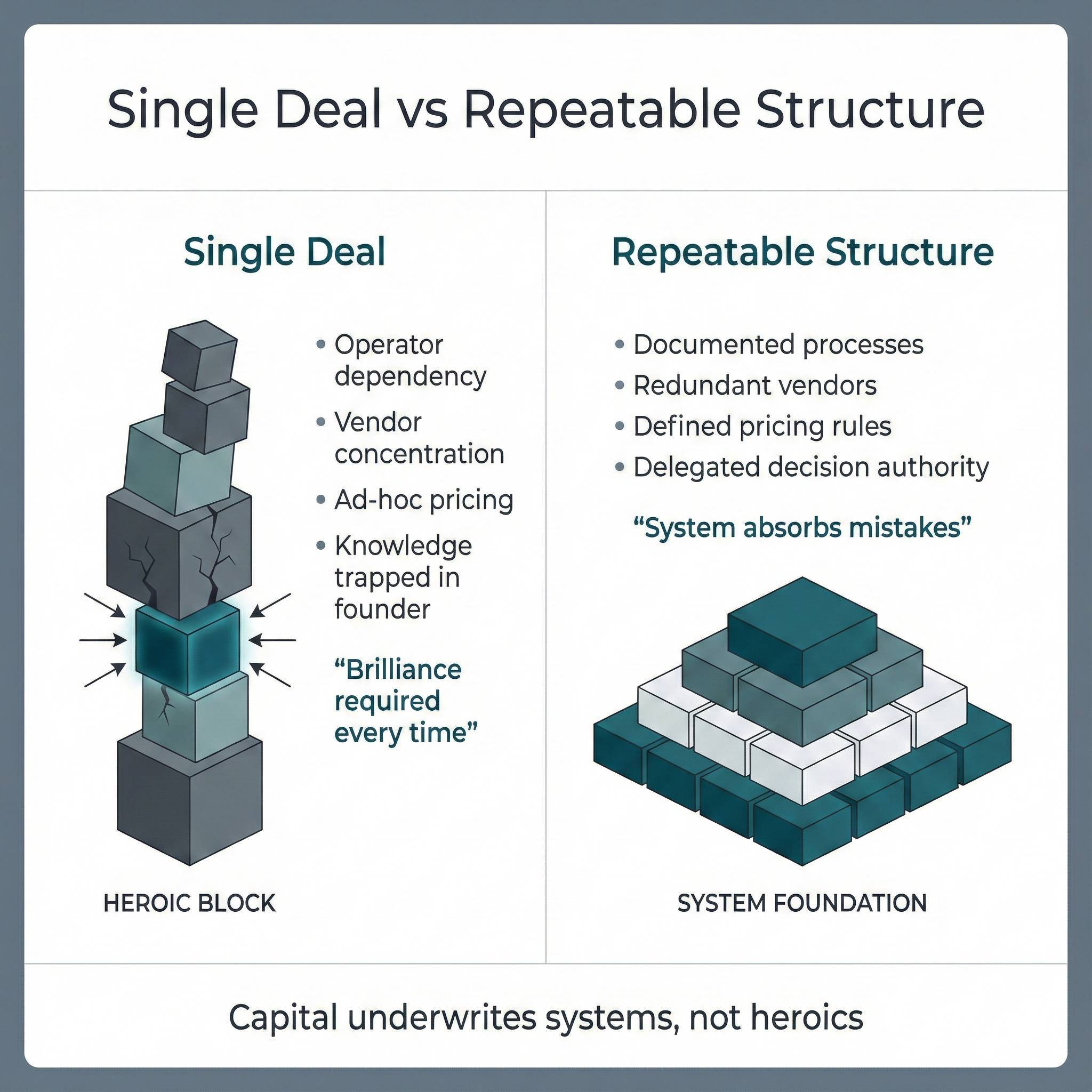
Here is what capital quietly asks:
“Will the next deal look like the last one?”
If you cannot answer that clearly, you are not raising equity. You are asking for a favor.
The Repeatability Test
Ask yourself:
- Would I do this deal again?
- Would I do it at half the returns?
- Would I do it if one assumption failed?
If the answer changes dramatically, capital notices.
Repeat sponsors raise faster not because they are smarter but because their behavior is predictable.
3. Risk Language Matters More Than Upside Language
Anyone can talk returns.
Very few people can calmly explain:
- What breaks
- When it breaks
- How bad it gets
- What happens next
This is where most capital conversations die.
Not because the deal is bad.
Because the operator sounds unaware.

Bad Risk Language:
- “We don’t see much risk”
- “Downside is limited”
- “That’s unlikely”
- “We’re confident”
Mature Risk Language:
- “This is the primary risk”
- “Here is how often we’ve seen it”
- “Here is what we do when it happens”
- “Here is what remains exposed”
Calm risk articulation signals maturity. Maturity attracts equity.
4. Proximity Beats Outreach
You do not build real capital relationships by asking.
You build them by:
- Being present where serious operators already are
- Contributing thinking without an agenda
- Letting time do the filtering

Capital does not like being hunted.
It prefers to observe.
This process is slow, but that’s the point.
People who feel entitled to capital always move too fast. People who understand capital move deliberately.
What Capital Actually Watches (But Never Says)
Capital is always watching four things long before it invests.
- How you talk when things are going well. Do you over-credit yourself? Do you attribute success to insight instead of conditions?
- How you talk when things go wrong. Do you explain? Do you deflect? Do you panic? Or do you calmly diagnose?
- Whether your behavior is consistent. Do your words match your actions? Do your numbers match your tone?
- Whether you need the capital. Needing capital is not disqualifying. But sounding dependent is. Capital avoids emotional dependence.
The Capital Readiness Checklist
Before you raise real equity, ask yourself:
- Can I explain my last deal without excitement?
- Can I explain my worst case without fear?
- Can I show three decisions that did not go my way and why they were acceptable?
- Can I explain what I would do differently next time?
- Can I walk away from this capital if needed?
If any of those feel uncomfortable, that is the work.
Why This Feels So Hard & What Changes the Game
Most people don’t struggle to find capital because they lack access. They struggle because their thinking creates friction.
It feels hard for most entrepreneurs because the work here is not tactical. Better marketing or a more clever structure won’t save you.
If you want to play the long game with serious equity, this is the work:
Clear thinking.
Repeated execution.
Quiet confidence.
Not more hustle, better decks, or warmer intros.
If you remove uncertainty, capital finds you.
PS: A few seats left for Montana. 2 days. My home. The kind of room that changes how you attack 2026. Click Here to Apply

Next steps
Action is the Advantage
If you’re like me, your to-do list is long. So I pulled out the highest-leverage actions from this week’s newsletter.
✓ Write a “risk-first” version of your pitch, with zero upside language.
✓ Reach out to a capital partner you’d like to work with, with no ask.
✓ Reply to this email with any roadblocks, and I’ll give you my two cents.
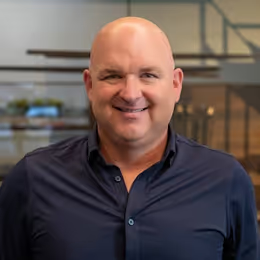
Vic Keller
17x founder. 9 exits. 3 to Berkshire. Subscribe to get the advantage I wish I had when I started.